



The spectre of eviction has continued to haunt the peoples of the Sundarban forests since the colonial times, if not since even further back. Come circa 2024, and this spectre has turned into Damocles’ sword. More than 1 lakh fishers face eviction in the Indian part of the Sundarbans as I write this.
Over 2 million people subsist on the Indian Sundarbans. Depending on seasonal variations in livelihood patterns, this number can be higher than 5 million. And this is based on the 2011 Census data. There is no telling if the number has increased, decreased, or remained the same. Varying patterns of rising out-migration, affected further by the phenomenon of ‘distressed reverse migration’ as observed onset and spread of Covid 19 and its consequent lockdowns, make it impossible to estimate the exact number of people in India who live close to the Sundarban forests and depend on the forests for their survival and sustenance.
Nonetheless, there can be no denying that anything between 1 to 1.5 lakh fishers depend on the Sundarbans for their livelihood. Likewise, there can be no denying that all these people are facing grave and imminent peril of eviction from their traditional geographical areas of livelihood on multiple counts. Let’s see how and why. But, let’s first look at the lives and livelihoods of the people who are facing this eviction.
Forming fishing-teams constituting three, four or five persons, the traditional small-scale fishers of the Sundarbans go out on seasonal fishing expeditions in the marine and estuarine waterways of the Sundarbans. The boats they go out on are non-mechanised – called ‘dinghy’ or ‘dinghee’ in local parlance – a word that had crept into the English language from South Bengal during the colonial times. They take turns to manually pull the oars, coursing through the tidal waterways of the Sundarbans, collecting fish, crab and at times honey.
The number of days during which a fishing team stays out on their dinghee-boats in the waters of the Sundarbans is determined by them based on the season, weather, climate, availability of fish-stock along the routes, etc., and through customary calculations based on tidal activities and the lunar calendar. For example, July 31, 2004 was the 11th day of the lunar fortnight, known as Ekadoshi in Bangla. On that day, many fishers from the Sundarbans have gone out or have tried to go out on fishing expeditions for their livelihood. They will fish in the waters of the Sundarbans for, what is known in Bangla as a ‘Gan’, pronounced as ‘gawn’.
‘Gan’ does not denote a specific number, but is a unit of measurement of the time spent journeying on a boat in relation to the distance covered and on lunar and tidal factors. (p. 766, Column 1, Bangiya Shabdakosh by Haricharan Bandyopadhyay, Sahitya Akademi, 1978 Reprint Edution). In the pre-colonial times, boat was a primary mean of conveyance in south Bengal, as it continues to be in the Sundarban delta.
Various ancient and medieval verses such as the Charyapada, the Dharmamangal, Manasamangal – attest to this usage of the word Gan in Bangla and proto-Bangla literature since at least the Pala era till the onset of colonial rule over Bengal. This word has since fallen out of usage in the baboo-Bengali bhadralok-parlance of modern-day Kolkata, swathes of which used to be a part of the Sundarban mangroves till at least the last half of the 18th century. Instead, it continues to be a word connected with the livelihood and of the few lakhs of small-scale fishers on the Sundarbans. For them, it is a very familiar and important word.
Coming back to the question of the time period for which the fishers can stay and pursue their livelihood, it is pertinent to note that the forest department usually issues a 42-day permit. In practice, it is seen that most fishing teams in the Sundarbans catch fish and crab in the forests for a few weeks to a month or so. One of the primary impediments to their traditional livelihood is posed by the license-permit raj that prevails in terms of governance in and of the Sundarbans.
Permits to enter the forests are issued only to those fishing teams who can show a curious document called the Boat License Certificate (BLC). The forest department has been unable to come up with any legal or administrative source-document to establish the validity of these BLCs. It has merely given a list of 923 BLCs that it had given, of which nearabout 700 are active. In local parlance, these are called ‘Tiger BLC’s.
Some sources indicate boat registrations done between 1923 and the mid-1940s leading to the evolution of these Tiger BLCs. Popularly prevalent oral hearsay, bordering on mythmaking, refer to some such certificates being given in the 19th century by the Dalit businesswoman Rani Rashmoni (1793-1861) who had a thriving fish trade along the riparian routes of southern Bengal.
In reality, one dinghee-boat cannot accommodate more than 4 or 5 fishers. When we look at the prevalence of nearabout 700 BLCs in a place like the STR where more than 1 lakh traditional small-scale fishers seek to pursue their traditional livelihood, and where more than 10 lakh dinghee-boats operate seasonally, the gap between demand and supply becomes clear. This disparity has led to the growth of a shadow economy around the marine fishing sector of the Sundarbans.
More than 500 of the 700 BLC-holders do not go for fishing themselves. They rent their BLCs out. As the situation has come to be, BLCs go through a series of subletting and middlemanship. Because of this, the illegal rent prices have skyrocketed. Ultimately, a team of small-scale fishers needs to come up with around Rs. 1 lakh or nearabout so to rent a BLC before they can get a forest-entry permit based on the same.
For instance, Sachin Mondal and his friend Rashid Gaji from Songaon, both traditional fishers hailing from a village in the Gosaba administrative block of the Sundarbans, were told to come up with a hefty amount of cash by the BLC-owner from their village. Being unable to do this, they have not been able to go into the Sundarban forests for fishing on the Gan that begun on 31st July, 2024 – Ekadoshi as per the vernacular lunar calendar.
Even for their friends and neighbours who could go, their journey has not been smooth sailing. The small-scale fishers of the Sundarbans live well below the poverty line and hail from historically oppressed communities. It is difficult for them to come up with Rs. 1 lakh to procure a BLC on rent, even if they split the expenses among three or four of them who are to constitute a fishing team. There are other initial investments required too – provisions of salt, ice, fuel and gear are required to be there in the boat during their fishing Gan, which can last from a fortnight to a month or so.
To afford these costs, the small-scale fishers need to take out advance loans from the Arotdars. As stockists, merchants and commission-agent, Arotdars have formed a key interface between fishers and farmers on one hand and the consumer market on the other, since pre-colonial times. According to Bongiyo Shabdokosh, Haricharan Bandyopadhyay, 1966, the word Arot is also present with the same meaning in the Maithili, Hindi, Sindhi, Gujrati and Marathi languages.
Traditionally, the Arotdars offer a form of earnest money or pledge money, known in vernacular Bangla parlance as ‘dadon’ – a word originating from the Farsi term ‘dadni’. The system of dadans has also existed since pre-colonial times, whereby such commission-agents or other middlemen used to offer the initial amount of money required for farming or fishing to landless farmers or tenureless fishers. Exploitative extraction leading from dadan-pledges offered by indigo commission agents was one of the primary factors that led to the Indigo Resistance (1859-1862) of Bengal
Needless to say, the small-scale fishers who take dadon-loans from the Arotdar have to repay the same – traditionally by giving them one-thirds of the fish and crabs collected from the Sundarban-waters. Rampant loan-sharking affects the vulnerable fishers massively. According to Nishith Gayen, a traditional small-scale fisher from Chhotmollakhali, a forest-adjacent village in the South 24 Parganas, his family needs to earn at least 2 or 2.5 lakhs every year to sustain themselves and maintain a bare minimum of dignified life. Rising BLC-rents and corresponding rising dadon-amounts are sharply eroding their livelihood security. As is the continual expansion of the core area and consequent reduction of the buffer region of the STR where the fishers are allowed to fish by the forest authority, added with the realities of relentless and unchecked tourism, cargo and fly-ash carriage activities in large dilapidated marine vehicles, and large-scale trawler-based commercial and mechanised fishing, which have reduced the fish-stock in the buffer-region drastically.
The fishers have to pay a hefty fine if they enter the purportedly ‘prohibited’ core area of the STR. the fine amounts payable by the fishers on such entry into the core area have continued to get steeper. During the fishing season of 2023, the fine amount payable on first such instance of entry into the core area of the STR was Rs. 750. In the current season, the forest department has suddenly raised it to Rs. 1150, without any prior intimation to the fishing community.
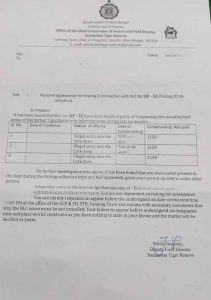 Notice Issued by Dy. F.D. STR revealing rising fine amounts within the same fishing season of 2023, i.e., the immediately last fishing season. Addressee details removed for privacy. As it happens, this notice was posted to the addressee by the STR after the date of hearing mentioned in it.
A Notice reflecting rising fines payable by the STR fishers in 2024, Addressee details removed for privacy.
Armed forest personnel connected to the local beat and Range offices regularly seize without receipt and destroy the boats, fishing gears, nets, fish and crabs, firewood, and even much needed food and fresh water in possession of the fishing teams – all under the pretext of blaming the fishers for their entry into the forest areas. Beatings and detentions are not uncommon. Fearing the onslaught of such brutality, many fishing boats try to enter narrow creeks with forest-cover on both sides to hide from the forest department’s patrol boats, thus exposing themselves to wildlife attack.
Tiger attack claims the lives of more than 30 traditional fishers in the Indian Sundarbans every year. During the years of the Covid 19 pandemic-induced lockdown, the number was higher – as conversations with the local people of Sundarbans indicate. Fear of the brutalities perpetrated by the forest authorities on the local fishers based on legally unsubstantiable allegations of so-called “illegal entry” leads to under-reportage of such incidents.
Nearly every fisher of the Sunderbans have lost one or more of their family members, friends, neighbours and fellow-community members to tiger or crocodile attacks while pursuing their livelihood. This is a source of severe health stress, including psychological issues, for nearly all of them. Since the colonial times till date, the forest and other state-authorities have continued with the saga of systemic and systematic denial of their relief, recompense and welfare…
For more details, please visit: https://countercurrents.org/2024/08/on-the-imminent-eviction-of-more-than-1-lakh-small-scale-fishers-of-the-indian-sundarbans-from-their-traditional-livelihood/